Out-of-Home Advertising: advertising that comes to life in cities
On this page
In the world of contemporary communication, where digital media seems to dominate every aspect of daily life, there is one form of advertising that stands the test of time and continues to evolve: out-of-home advertising. This encompasses everything visible outside the home: billboards, posters, digital screens and installations in public spaces.
Despite the growth of online campaigns, out-of-home advertising retains a communicative power that many other channels would envy: it is impossible to ignore, woven into the fabric of daily life and capable of surprising, moving and engaging people.
What is out-of-home advertising?
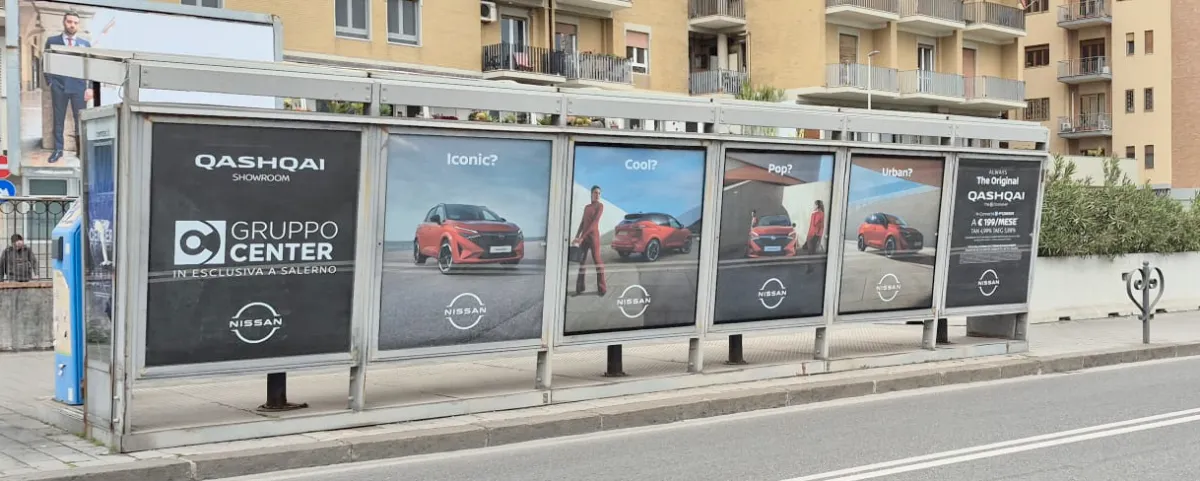
The term ‘out-of-home advertising’ (often abbreviated to OOH advertising) refers to all forms of advertising that reach the public outside the home. This includes not only traditional roadside billboards, but also branded transport, customised bus shelters, banners in stadiums, LED walls and digital totems.
We are talking about:
- Traditional outdoor advertising: static billboards, wall posters, 6×3 formats, standard installations.
- Digital out-of-home (DOOH): programmable digital screens capable of displaying dynamic content based on the time of day, the weather or geolocation.
The variety of formats and contexts makes out-of-home marketing an extremely versatile tool, capable of adapting to any type of brand and message.
Why does out-of-home advertising still work?
Anyone who thinks out-of-home advertising is an outdated strategy may not have considered its real strength: its ability to blend into everyday life without being perceived as intrusive. Every day, people walk the same streets, wait for buses, and get about by car or on foot. It is at these moments that outdoor advertising comes into play, making a powerful visual and spatial impact.
The benefits of OOH advertising
- Constant, non-intrusive
visibility You can’t ‘skip’ a billboard the way you can with a advert on YouTube. OOH is present, day and night, in strategic locations. - Emotional impact and memorability
A well-designed billboard, with striking graphics and a clear message, can become iconic. Outdoor advertising relies heavily on the ‘wow’ factor, on catching the eye and on evoking emotion. - Wide reach
OOH advertising reaches a broad audience: motorists, pedestrians, tourists and commuters. A well-distributed campaign can ensure extensive coverage at local, regional or national level. - Integration with digital
media Thanks to QR codes, augmented reality or simply the synergy between billboards and social media, out-of-home advertising can now serve as the starting point for an omnichannel marketing strategy.
The evolution of outdoor advertising: from posters to data
In recent years, outdoor advertising has undergone a profound transformation. It is no longer simply a matter of putting up a billboard in a busy area: today, digital technologies allow for planning with scientific precision.
With DOOH, it is possible to:
- change the message in real time;
- schedule content based on the time of day, the weather or events in the city;
- collect data on footfall and exposure times;
- geotag content to target specific audiences.
All of this brings out-of-home marketing ever closer to the logic of digital advertising, but with the added value of real, tangible impact.
When and how to use OOH advertising
An out-of-home campaign works when it is carefully planned, from the choice of location to the creativity of the message. It is important to consider:
- Urban context: where is the billboard located? Who will see it? At what time of day?
- Essential creativity: the message must be understandable in a matter of seconds, with striking images and clear copy.
- Measurable objectives: brand awareness, a call to action, promotion of an event or product launch.
Furthermore, integrating OOH with other tools – such as social media campaigns, influencer marketing or in-store promotions – helps to maximise its effectiveness.
Digital Out of Home (DOOH) figures
The Digital Out of Home (DOOH) sector is showing significant growth. According to the Out of Home Advertising Association of America (OAAA), in 2023 DOOH accounted for 33 per cent of total out-of-home advertising spend, representing growth of nearly 10 per cent compared with the previous year.
Furthermore, the global out-of-home advertising market was valued at $28.48 billion in 2023 and is forecast to reach $67.96 billion by 2032, with a compound annual growth rate (CAGR) of 9.7 per cent over the forecast period.
These figures highlight how DOOH is becoming an increasingly significant component of the advertising landscape, offering new opportunities for creative and targeted campaigns.
The future of out-of-home advertising
The future of out-of-home advertising is increasingly interactive, sustainable and personalised. The trend is towards smart billboards, powered by renewable energy and connected to databases to analyse effectiveness in real time.
Creativity is also evolving: billboards are becoming experiences, installations and temporary artworks that interact with the urban landscape and with people. OOH is moving beyond being merely a sales tool to become content, visual culture and an event.
In conclusion, whilst digital marketing is indispensable, outdoor advertising continues to offer something no other channel can provide: a physical presence in the real world. And in an age where everything is mobile, fleeting and scrollable, perhaps this is precisely its greatest strength.