Santoro Creative Hub: a heart-safe company that invests in workplace safety
On this page
Providing a safe working environment and ensuring the safety of all staff are two essential steps for any type of business.
To this end, at Santoro Creative Hub, we recently organised a course on first aid in the workplace and the use of a defibrillator for some of our staff, in partnership with the Corpo di Soccorso Universo Humanitas.
The course consisted of two days of training, devoted to theory and, above all, practical sessions, with particular emphasis on the technique of chest compressions, the use of a defibrillator, and the Heimlich manoeuvre.
How to become a heart-safe organisation
The first aid course is intended for employers and employees designated as first aiders, as required by Ministerial Decree 388/2003.
The defibrillator training (Balduzzi Decree No. 158/2012) is a theoretical and, above all, practical course necessary for training staff in BLS procedures using a semi-automatic external defibrillator.
The obligation to provide such training depends on the type of organisation and, although Santoro Creative Hub was not legally required to do so, we considered it essential to ensure the safety of our staff and to further improve our corporate welfare by becoming a ‘heart-safe’ organisation.
Cardiac massage and the defibrillator
The course was run by the Universo Humanitas Rescue Corps and lasted a total of 8 hours, spread over two days.
During the course, participants received comprehensive training in emergency procedures, including:
- first aid;
- choking first aid;
- cardiopulmonary resuscitation;
- the use of a defibrillator.
The first-aid course is essential for acquiring the skills needed to respond promptly in an emergency. Following the training, the first-aider will be able to correctly inform the relevant authorities about the condition of the casualty and the circumstances of the incident.
The manoeuvre to be performed in the event of choking is the Heimlich manoeuvre. It consists of a series of movements that help to clear the airway blocked by a foreign body, such as food or other objects, which are causing the choking. The Heimlich manoeuvre is a vital first-aid procedure and must be carried out promptly in an emergency.
Cardiac massage, also known as cardiopulmonary resuscitation (CPR), is a fundamental first-aid procedure for maintaining the flow of blood and oxygen to the brain and vital organs of a person in cardiac arrest. This technique involves rhythmically compressing the affected person’s chest to stimulate the heart to pump blood around the body.
The semi-automatic external defibrillator (AED) is a crucial device for saving lives in the event of cardiac arrest and is strongly recommended in every community setting. Equipped with advanced sensors, the AED is able to recognise cardiac arrhythmias and automatically determine whether defibrillation is required.
The deployment of defibrillators within the company
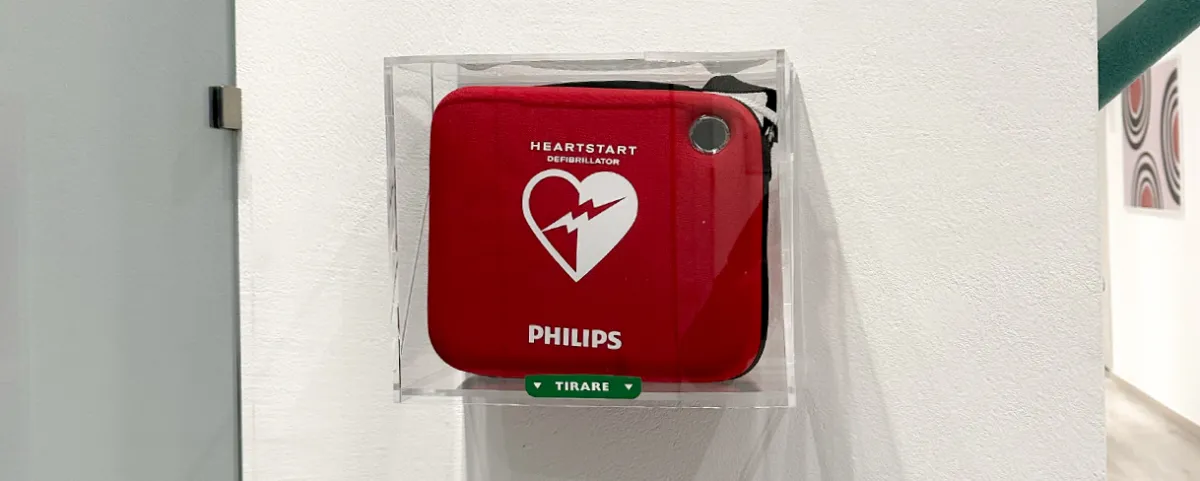
At Santoro Creative Hub, we have invested in the safety of our staff by installing two defibrillators on the premises: one on the ground floor and the other on the upper floor.
This strategic placement ensures that a defibrillator is always within reach in the event of an emergency, regardless of where on the premises the emergency occurs.
Conclusions
Health and safety at work is a top priority for Santoro Creative Hub. A safe and secure working environment for everyone who works with us is of paramount importance.
Investing in the training and resources needed to manage emergency situations is essential for the wellbeing and safety of everyone who is part of our organisation.
Through our ongoing commitment to workplace safety, Santoro Creative Hub reaffirms its position not only as a leading company in the communications sector, but also as a benchmark for best practice in terms of corporate welfare and employee wellbeing.